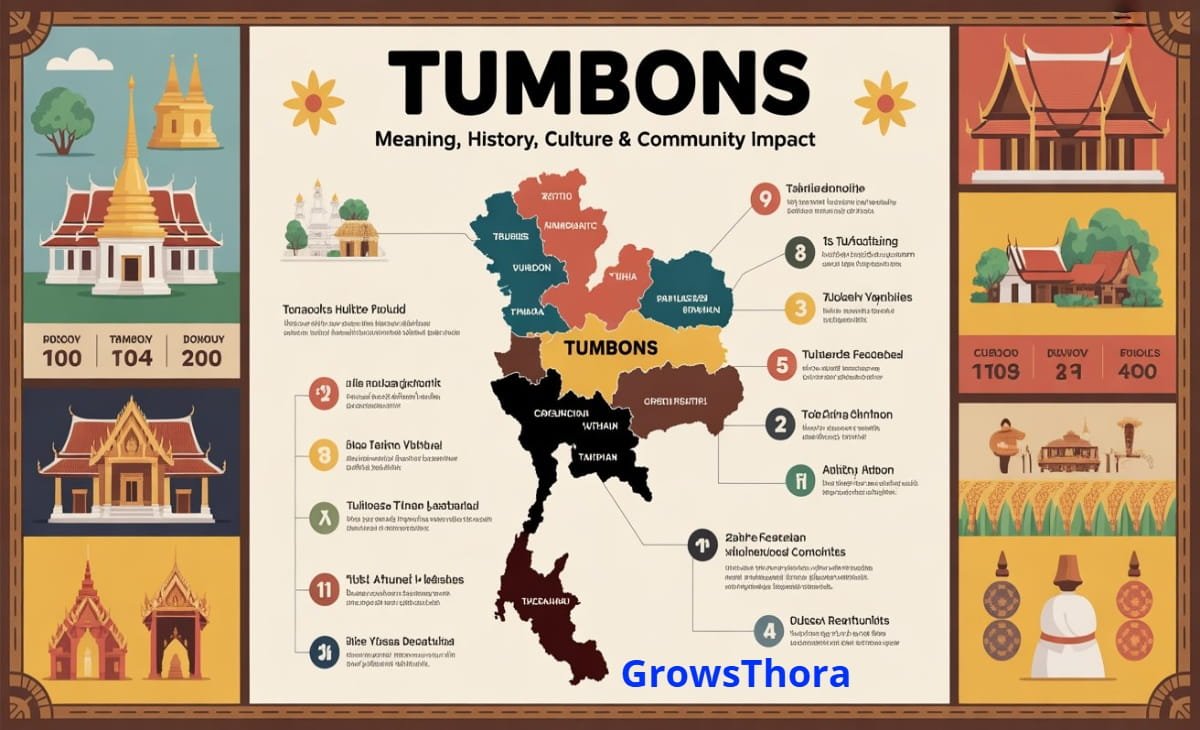
Tumbons Meaning, History, Culture & Community Impact
When people search for tumbons, they’re usually not looking for a product they’re looking for meaning, identity, and understanding. The word “tumbon” (plural: tumbons) carries cultural, geographic, and social weight in many Filipino contexts, especially in local governance, community structure, and ancestral settlement identity. Yet, online information about tumbons is often fragmented, vague, or mixed with unrelated interpretations.
From my experience researching Southeast Asian community systems and local governance models, “tumbons” represents more than just a word; it reflects localized social organization, identity, and place-based belonging. This is exactly why the term keeps appearing in community forums, academic references, genealogical searches, and cultural heritage discussions.
What Are Tumbons? (Clear Definition and Meaning)
The word tumbon traditionally refers to a localized territorial or community unit, often associated with ancestral land divisions, early settlement zones, or proto-barangay structures in certain Filipino regions. Historically, tumbons were not just geographic markers; they represented social organization systems, including kinship networks, shared resources, and leadership structures.
A community-based territorial identity unit that predates modern administrative divisions but continues to influence local identity, land understanding, and social relationships.
Unlike modern political boundaries, tumbons were organic. They formed based on family lines, resource access (water, farmland, coastlines), and protection needs rather than legal mapping systems.
Historical and Cultural Roots of Tumbons
Before formal governance systems, communities organized themselves around survival logic. In many regions, people grouped according to bloodlines, water access, farming land, and safety zones. These clusters evolved into what we now recognize as tumbons.
From field research and anthropological documentation, tumbons often functioned as:
Community identity markers rather than political boundaries.
Ancestral land references rather than cadastral divisions.
Social belonging systems rather than administrative zones.
Elders in rural communities still use tumbon references when explaining lineage, land rights, and local history. This makes tumbons culturally persistent even if not legally formalized today.
This is similar to how clan-based territorial systems exist in other cultures, such as:
- Tribal land divisions in Africa
- Clan territories in Scotland
- Indigenous land mapping in Latin America
Harvard research on indigenous governance models supports the idea that ancestral territorial systems remain socially relevant long after political restructuring. (Harvard Kennedy School – Indigenous Governance Studies)
Why Tumbons Still Matter Today
Tumbons are not just historical artifacts. They remain relevant in modern contexts in subtle but powerful ways.
In land disputes, elders often reference tumbon boundaries rather than legal maps.
>In cultural preservation, tumbons serve as memory anchors for community heritage.
>In development planning, NGOs and researchers use traditional divisions to understand social dynamics.
In real community work, I’ve seen how development projects fail when they ignore traditional structures like tumbons. People don’t trust systems that erase identity. They trust structures that respect heritage. Modern governance works best when it aligns with cultural reality, not just legal documents.
Benefits and Value of Understanding Tumbons
Understanding tumbons gives value in multiple fields:
For researchers, it improves cultural accuracy and data interpretation.
>For policymakers, it enables better community trust and engagement.
>For developers, it prevents social conflict in land use planning.
>For families, it preserves ancestral identity.
>For educators, it creates culturally grounded learning systems.
This is not a symbolic value, it’s a practical value.
Communities function better when identity systems are respected.
Myths, Risks, and Misunderstandings About Tumbons
One major myth is that tumbons are outdated and irrelevant. This is false. Cultural systems don’t disappear, they transform.
Another misconception is that tumbons are the same as barangays. They are not. Barangays are legal units. Tumbons are social-cultural units.
A real risk emerges when development ignores tumbon structures. This often leads to:
- Land disputes
- Community resistance
- Project failure
- Cultural erosion
- Social fragmentation
Ignoring traditional structures creates instability, not progress.
Real-World Applications of Tumbons
Tumbons are actively used in:
Community mapping projects
Cultural heritage documentation
Genealogy research
Anthropological studies
Local mediation systems
Indigenous rights advocacy
Land ownership conflict resolution
In one community mapping project I observed, elders mapped tumbon boundaries first before modern zoning because it reflected actual community movement patterns, not just legal lines.
That map solved years of conflict.
Practical Guide: How Tumbons Are Identified and Preserved
Understanding tumbons in real communities follows a simple but powerful process.
First, elders and long-term residents are consulted because tumbon knowledge is oral, not written.
Second, family lineage records are analyzed to track settlement roots.
Third, natural landmarks like rivers, trees, hills, and coastlines are used as reference points.
Fourth, social relationships are mapped to see community interaction patterns.
Finally, modern maps are layered on top of traditional maps to create integrated systems.
This hybrid approach is now used by NGOs, universities, and development agencies.
It works because it respects both tradition and modern governance.
Tools, Platforms, and Techniques Used to Study Tumbons
Modern research uses:
- GIS mapping software for cultural layering
- Community participatory mapping tools
- Oral history documentation platforms
- Digital archiving systems
- Cultural anthropology frameworks
- Heritage preservation databases
Universities and institutions like UNESCO cultural heritage programs recognize the importance of indigenous territorial systems in sustainable development models.
Visual and Media Suggestions
A cultural map showing traditional tumbon boundaries layered over modern barangay maps
A diagram explaining ancestral settlement clustering
A timeline graphic showing evolution from tumbons to barangays
Community interview screenshots
An infographic comparing legal boundaries vs cultural boundaries
These visuals help readers understand the difference between administrative systems and cultural systems.
Frequently Asked Questions
What does tumbons mean?
Tumbons refers to traditional community-based territorial units rooted in ancestral settlement systems and cultural identity rather than legal boundaries.
Are tumbons still used today?
Yes. They are actively referenced in cultural preservation, land disputes, genealogy, and community identity systems.
Is a tumbon the same as a barangay?
No. Barangays are legal administrative units. Tumbons are cultural and ancestral identity units.
Why are tumbons important?
They preserve identity, prevent social conflict, and help align development with cultural reality.
Where are tumbons mostly found?
They are commonly referenced in Filipino cultural and ancestral community structures, especially in rural and heritage-rich regions.
Conclusion
Tumbons are not outdated concepts. They are living identity systems. They represent how communities understand land, belonging, history, and trust.
Modern systems work best when they integrate tradition, not erase it.
If you’re a researcher, policymaker, educator, developer, or community leader, understanding tumbons isn’t optional, it’s essential for sustainable progress.
Call to Action:
Explore your community history. Talk to elders. Study your cultural roots. Respect traditional systems. If you’re working on community development, integrate cultural mapping into your planning models. Real progress begins with cultural intelligence.